The standard marketing line for a dive destination is a species list. We have frogfish. We have nudibranchs. We have seahorses. Come visit.
Anilao does have frogfish. It has more species of nudibranch than any place on Earth. It has seahorses — including pygmy seahorses smaller than your fingernail, clinging to gorgonian fans at twenty metres. But a species list doesn’t capture what diving Anilao actually feels like. What captures it is the density. The strangeness. The fact that a single dive on a single site can produce encounters that divers in other parts of the world wait years to see.
This is a guide to what lives here, when you’ll find it, and where to look.
The Numbers
Anilao sits on the Verde Island Passage — the most biodiverse marine ecosystem ever measured. The numbers bear repeating because they are difficult to believe:
- 1,736 species of shorefish documented in ten square kilometres (Carpenter & Springer, 2005)
- More than 400 species of coral — roughly 90% of all coral species on Earth
- Over 600 species of nudibranch — three-quarters of all identified species worldwide
- More than 50 dive sites along the Calumpan Peninsula
One marine biologist, surveying the reef, observed that there is a greater variety of fish within 100 square metres here than in all of the Great Barrier Reef. This is not a metaphor. It is a measurement.
The Critter Capital
Anilao’s international reputation rests on its macro and muck diving — the art of finding small, camouflaged, and improbable creatures on sand, rubble, and reef. The signature species are not large. Most of them fit in the palm of your hand. What makes them extraordinary is their behaviour, their camouflage, and their refusal to look like anything that should exist.
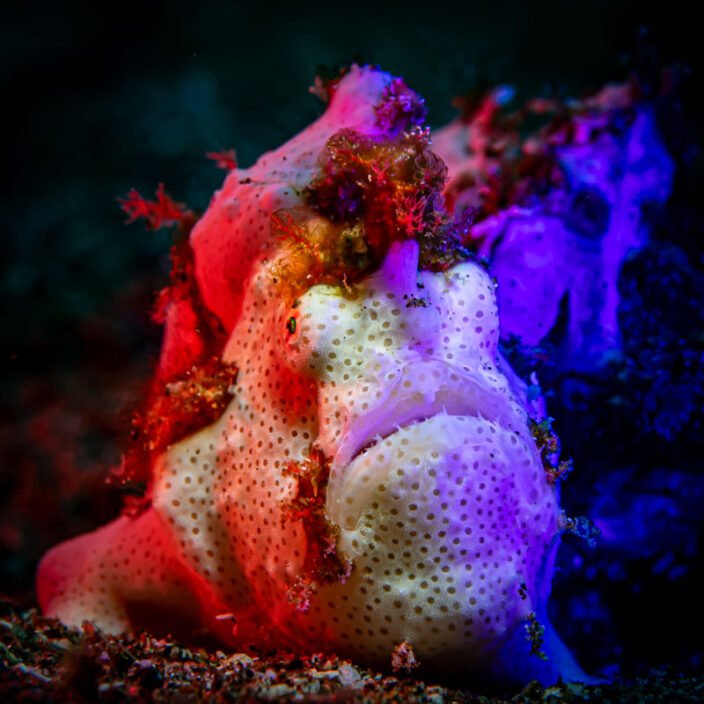
Frogfish
Anilao may have the highest density of frogfish in the world. At Mato Point — nicknamed “Too Many Frogfish” — divers have documented eight frogfish of different species, sizes, and colours within five square metres. Hairy frogfish (Antennarius striatus) in black, white, and orange. Painted frogfish (Antennarius pictus) mimicking sponges so precisely that you can stare directly at one and not see it. Giant frogfish (Antennarius commerson) the size of a football, sitting motionless for hours, waiting for a fish to swim past their lure.
Frogfish are found year-round, with peak abundance from January through March.
Flamboyant Cuttlefish
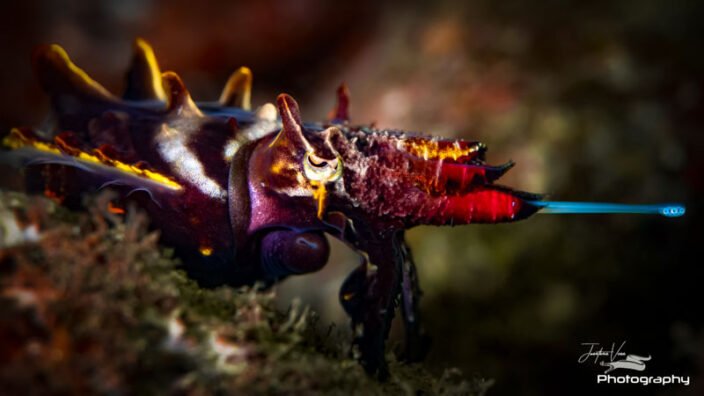
The flamboyant cuttlefish (Metasepia pfefferi) is the creature that makes underwater photographers lose their composure. It doesn’t swim — it walks across the sand on modified arms, pulsing waves of purple, yellow, and red across its body in patterns that change faster than you can track. It hunts by stalking, arms extended, then striking with a tongue-like tentacle so fast that high-speed cameras are required to capture it.
Found at muck sites including Secret Bay. Year-round, with particular abundance October through March.
The Octopus Assembly
Anilao hosts an unlikely gathering of the world’s most remarkable cephalopods.
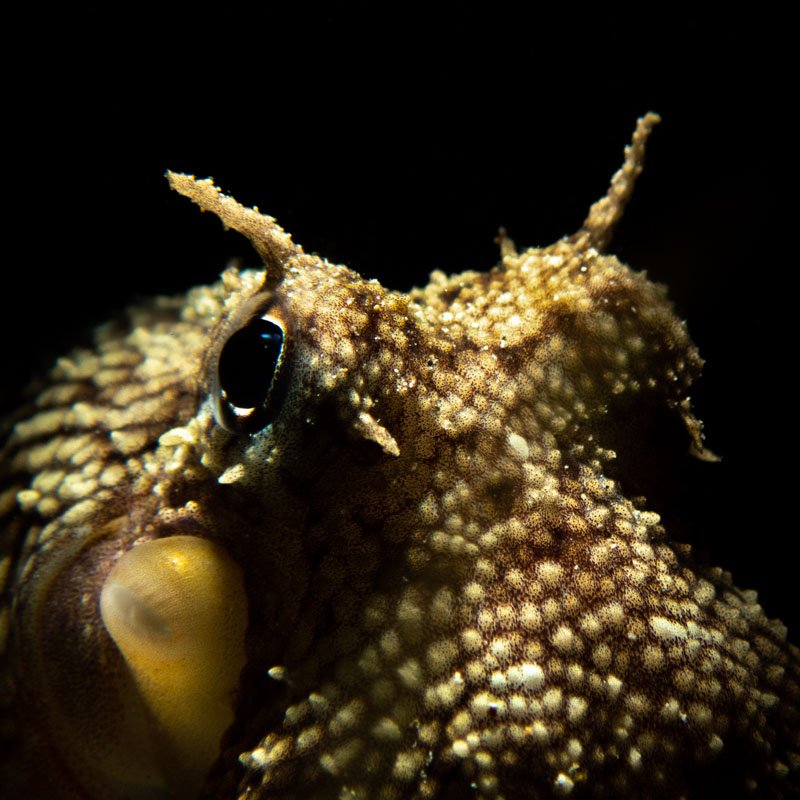
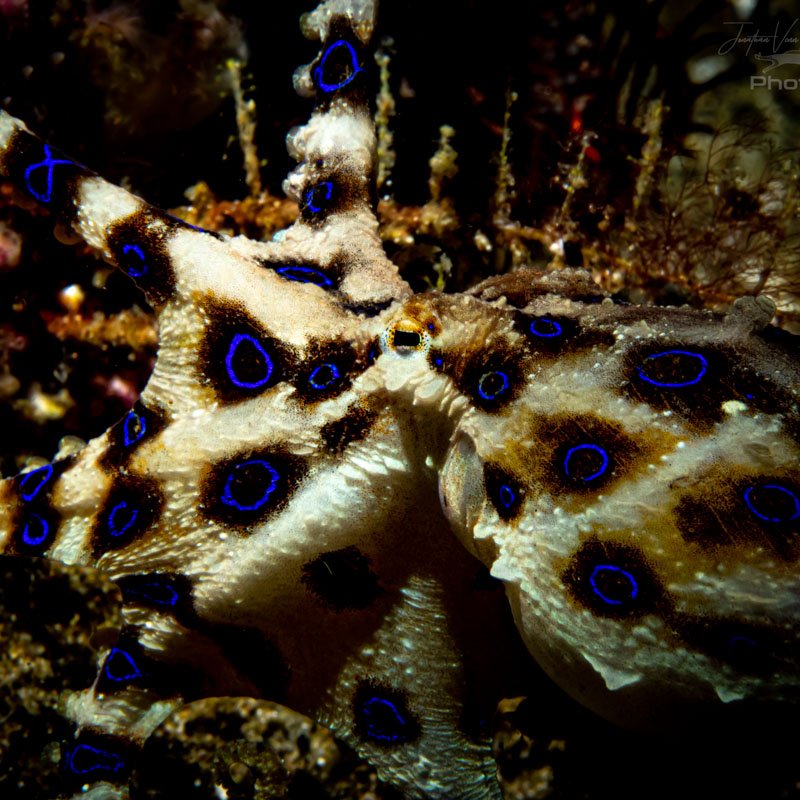
The blue-ringed octopus — one of the ocean’s most venomous animals — emerges on night dives, its iridescent rings glowing as a warning. The mimic octopus (Thaumoctopus mimicus) impersonates lionfish, flatfish, and sea snakes depending on the threat it faces. The wonderpus (Wunderpus photogenicus), often confused with the mimic, hunts with its arms spread like an umbrella, trapping prey beneath its webbing. And the coconut octopus (Amphioctopus marginatus) — documented by the Smithsonian at Anilao Pier — carries shells and coconut husks as portable shelters, one of the clearest examples of tool use in invertebrates.
All four species can be found at Secret Bay and Anilao Pier. The blue-ringed octopus is most reliably seen on night dives.
Scorpionfish
The Ambon scorpionfish (Pteroidichthys amboinensis) is a creature that looks like it was designed by a committee that couldn’t agree on anything — tasselled, hairy, warty, and perfectly invisible against the rubble of Secret Bay. Finding one is a test of the divemaster’s knowledge, because they do not move and they do not want to be found.
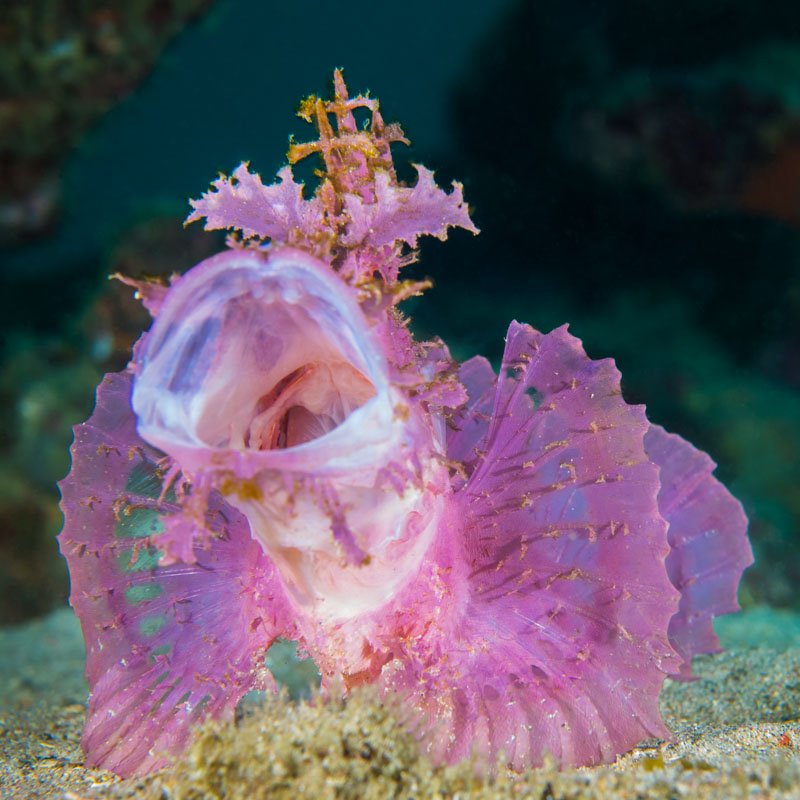
Rarer still are the Rhinopias — the lacy scorpionfish (Rhinopias frondosa) and paddle-flap scorpionfish (Rhinopias eschmeyeri). These appear seasonally, are never guaranteed, and are among the most prized sightings in underwater photography worldwide.
Seahorses and Ghost Pipefish
Pygmy seahorses (Hippocampus bargibanti and H. denise) live on gorgonian sea fans at depth, matching the colour and texture of their host so precisely that they are effectively invisible without a guide. One gorgonian in Anilao was documented hosting six pygmy seahorses — a density that borders on the absurd.
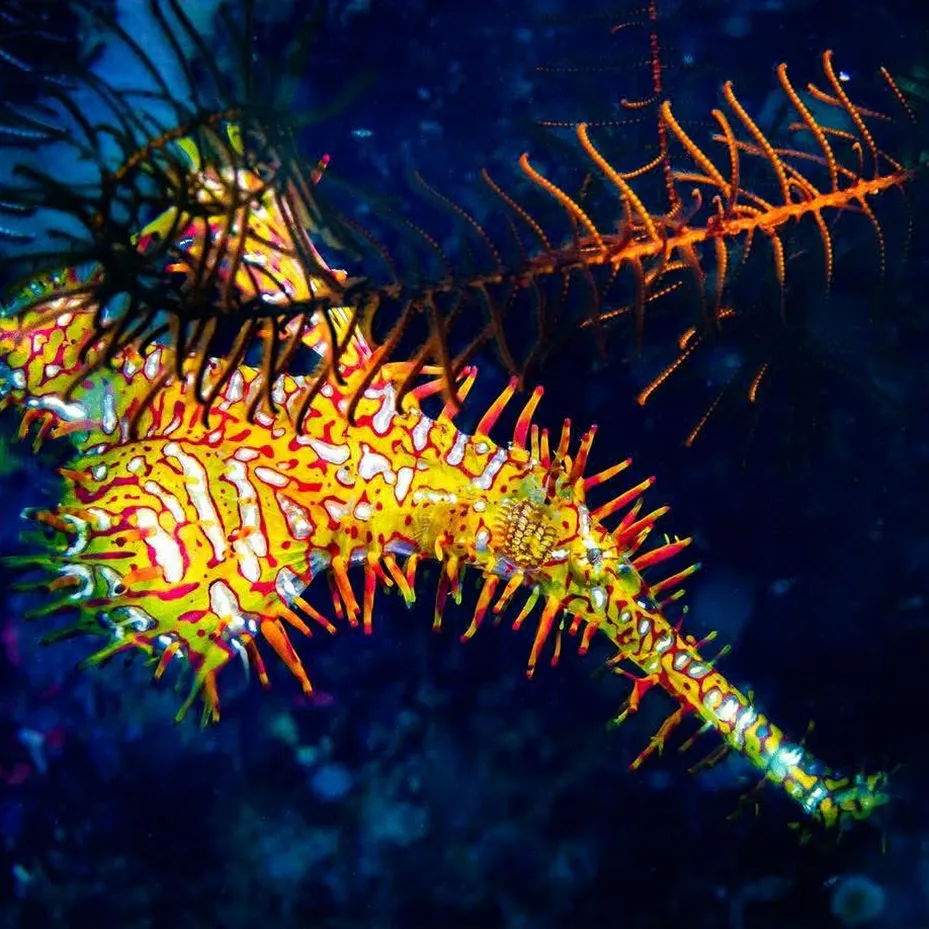
Ornate ghost pipefish (Solenostomus paradoxus) hover vertically, mimicking seagrass or soft coral fronds. They are everywhere in Anilao and nowhere at the same time — finding them is an exercise in learning to see differently.
The Nudibranch Capital of the World
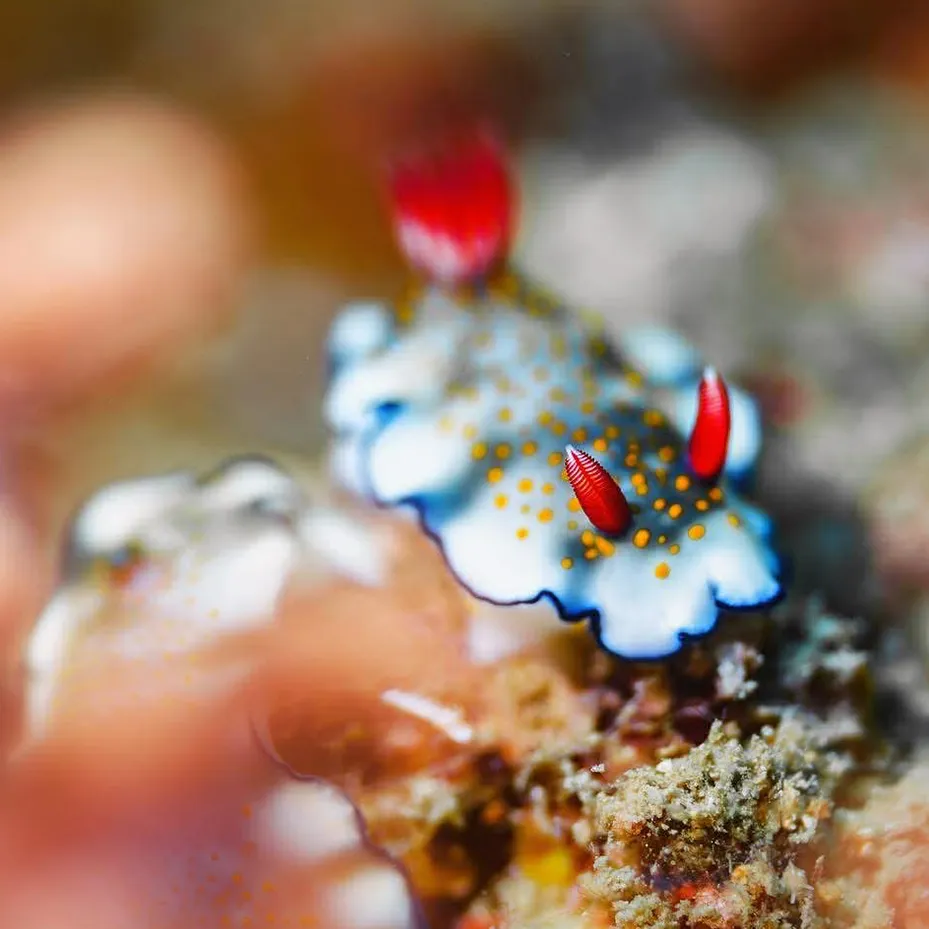
The title is not honorary. With over 600 documented species, Anilao holds more nudibranch diversity than any other location on Earth. One species — Halgerda batangas — is named after the province itself.
Nudibranchs are sea slugs that have abandoned their shells in favour of chemical defences and, apparently, an unlimited colour budget. They range from microscopic specks requiring macro lenses to the Spanish dancer (Hexabranchus sanguineus), a nocturnal species up to 60 centimetres long that undulates through the water column like a flamenco skirt in a current.
They are found year-round. On many dives, you will see species you cannot identify — not because your knowledge is lacking, but because science hasn’t catalogued them yet. Expeditions to the Verde Island Passage continue to discover new species with every visit.
By Season
Dry Season: November through May
This is Anilao’s prime diving window. Visibility reaches 15 to 20 metres. Seas are calm. Water temperature ranges from 26 to 30 degrees — though January and February can surprise with dips to 22 to 25 degrees, cold enough to warrant a 3 to 5mm wetsuit.
January through March is the peak period for critter abundance. Frogfish, flamboyant cuttlefish, and seahorses are at their most plentiful. Nudibranchs are everywhere. The water is cool, the creatures are active, and the photographers are out in force.
April and May bring the warmest water, the best visibility, and the most crowded resorts. If you want perfect conditions and don’t mind company, this is when to come.
Wet Season: June through October
The southwest monsoon — the Habagat — brings rain, chop, and reduced visibility (sometimes dropping to 3 to 5 metres after heavy downpours). Most tourists avoid this period. The divers who come anyway find something interesting: the macro life doesn’t diminish. In many cases, it intensifies.
Muck sites like Secret Bay and Anilao Pier produce different critter assemblages in the wet season. Fewer crowds mean more bottom time at popular sites. Resort rates are lower. And the creatures that have made Anilao famous — the frogfish, the octopuses, the nudibranchs — are residents, not visitors. They don’t leave when it rains.
October marks the transition back. Conditions improve rapidly, critter encounters remain excellent, and the reef has had months of relative quiet.
When the Sun Goes Down
Anilao’s night diving is among the best in the world. After dark, the reef transforms.
Mandarin fish mating at Lighthouse is Anilao’s signature twilight dive. At sunset, tiny mandarin fish (Synchiropus splendidus) — painted in psychedelic swirls of blue, orange, and green — emerge from the coral rubble to perform courtship dances. Males display for females in brief, frantic sequences. Pairs rise together in a spiral, release eggs and sperm simultaneously, and vanish back into the reef. The entire display happens in minutes, in fading light, and is one of the most sought-after behaviours in underwater photography.
Anilao Pier becomes a different world at night. At only five to six metres depth, the sandy bottom produces blue-ringed octopuses, bobbit worms (ambush predators that strike from buried tubes with terrifying speed), coconut octopuses on the move with their shell collections, and creatures that simply do not appear during the day.
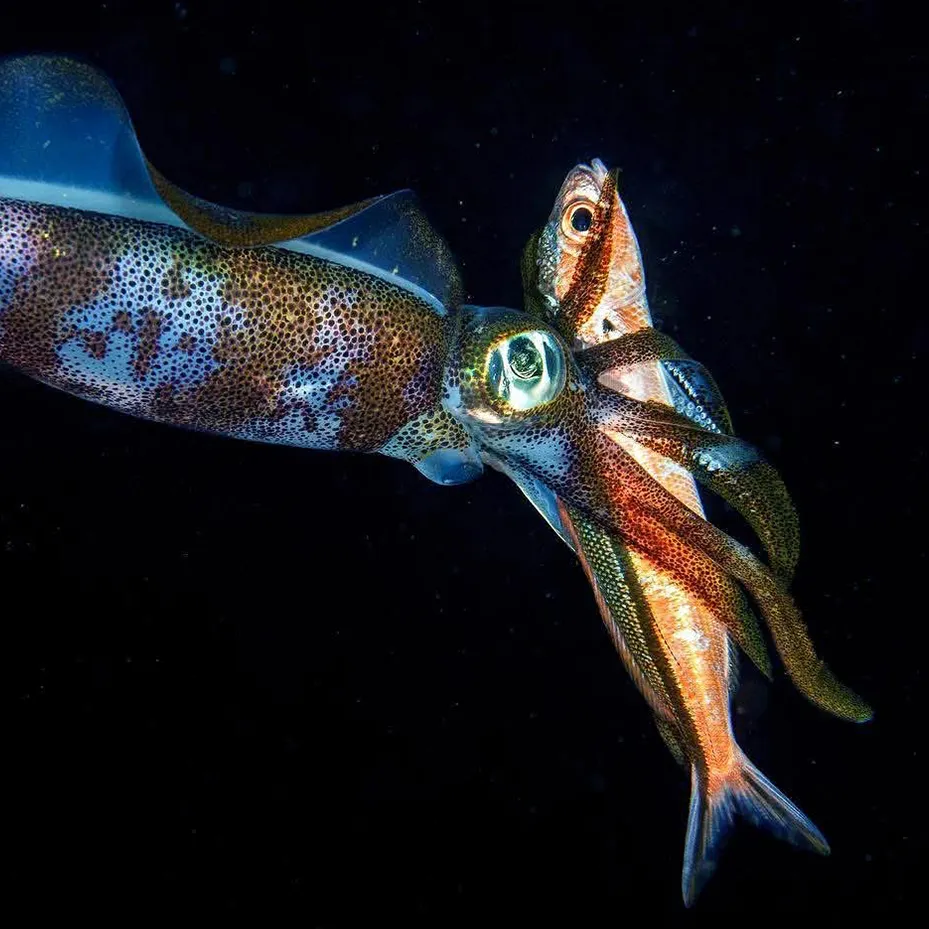
Twin Rocks hosts bobtail squid — tiny cephalopods hovering near the sand — and the Spanish dancer nudibranch, which unfurls its massive body to swim through the water column in undulating waves of crimson.
Blackwater: The Frontier
Anilao has become Southeast Asia’s capital for blackwater diving — a discipline that barely existed a decade ago.
The technique: a boat positions over deep water — 100 metres or more. A weighted, illuminated line is dropped into the abyss. Divers descend along the line into open water, surrounded by nothing but darkness and the glow of their lights. And then the deep ocean comes to them.
What rises from the depths is the stuff of science fiction. Argonauts — paper nautilus — trailing their delicate shells. Larval fish so transparent you can see their spines. Pelagic seahorses drifting on currents. Squid species that live their entire lives in the water column and have never been photographed alive. Organisms that have no common name because no one has bothered to name something that lives a thousand metres down and visits the surface for a few hours each night.
Blackwater diving requires advanced certification and a minimum of 50 logged dives. Its accessible cousin — bonfire diving — places lights on the sandy bottom at 10 to 20 metres, attracting larval creatures from the surrounding darkness. Less demanding, equally strange, and a good entry point for divers who want to see what happens when you light up the dark.
The Dive Sites
A few highlights from Anilao’s fifty-plus sites:
Secret Bay — The quintessential muck dive. Black volcanic sand, 10 to 40 metres. Mimic octopus, wonderpus, Ambon scorpionfish, frogfish, ghost pipefish, Coleman shrimp on fire urchins. Volcanic vents bubble from the seabed — a reminder that you’re diving on the flank of a supervolcano.
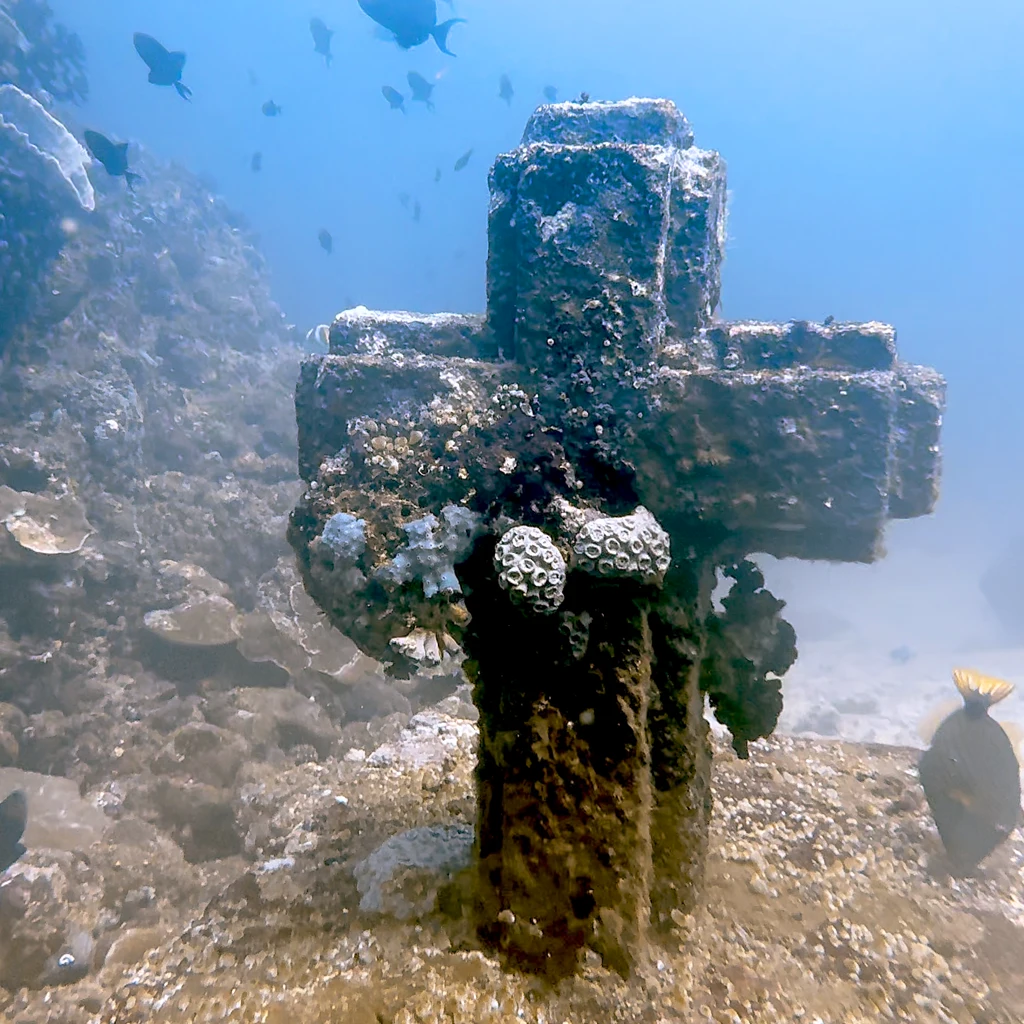
Cathedral Rock — Doc Tim Sevilla’s living monument. Swim-throughs between coral-encrusted boulders, a cross blessed by the Pope, and 67 species of coral on a formation that was bare rock fifty years ago.
Kirby’s Rock — A vertical volcanic wall in the middle of the Verde Island Passage. Strong currents bring jacks, barracuda, and the occasional surprise from the blue. This is Anilao’s closest approach to pelagic diving.
Mainit Point — Current-washed reef where great barracuda, giant trevally, and bluefin trevally patrol in numbers.
Sombrero Island — Walls and slopes with turtles, reef sharks, and colourful coral gardens.
Mapating Rock — The name means “lots of sharks” in the local dialect. A cave entrance at 45 metres where whitetip reef sharks have been found sleeping, and hammerheads have been sighted. Technical diving only.
Daryl Laut — A sunken floating casino, now home to resident batfish and encrusted in coral. Depths 10 to 40 metres.
What You Won’t Find Here
Anilao is not a pelagic destination. If you want whale sharks, go to Donsol. Thresher sharks are in Malapascua. Manta rays aggregate at Ticao’s Manta Bowl. Anilao doesn’t compete with those places because it isn’t trying to. What it offers is different: the most concentrated diversity of small, strange, and scientifically significant marine life anywhere on Earth.
That said — a day trip to Verde Island (two hours by bangka) adds dramatic wall dives with schooling jacks, surgeonfish, and tuna. Whale sharks have been sighted between February and April. And the Verde Island Passage itself has recorded 11 shark species and 13 species of dolphin and whale. The big stuff is out there. It just isn’t what makes Anilao extraordinary.
What makes Anilao extraordinary is the frogfish sitting on a sponge at twelve metres, perfectly camouflaged, waiting for a fish to swim past its lure. It’s the nudibranch the size of a grain of rice, painted in colours that shouldn’t exist. It’s the mandarin fish rising in a spiral at sunset, and the argonaut drifting up from a thousand metres of darkness at midnight.
It’s the reef that has been here since before anyone was looking — and the fact that, even now, it keeps showing us things we’ve never seen.
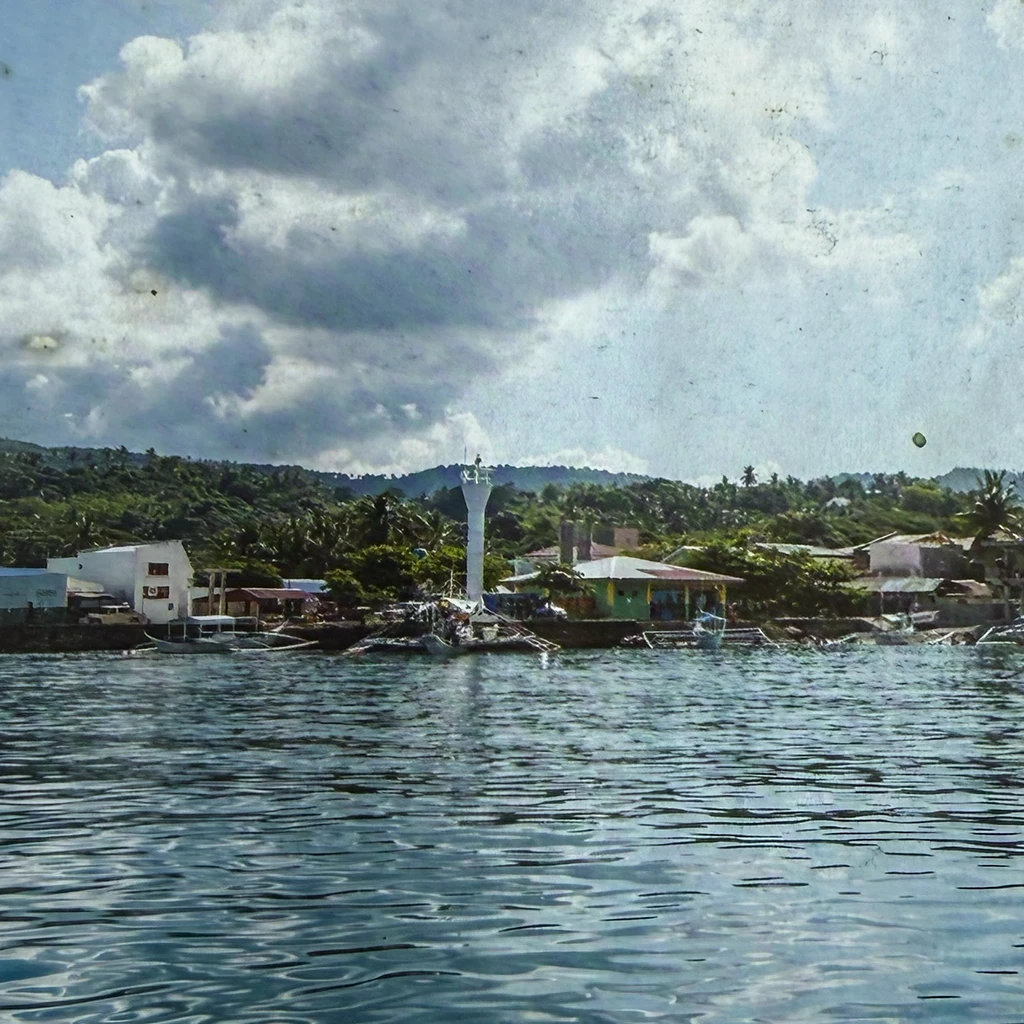
Blue Ribbon Dive Resort is located in Anilao, Mabini, Batangas — on the shore of the Verde Island Passage, in the most biodiverse marine ecosystem on Earth.
Sources
1. Carpenter, K.E. & Springer, V.G. (2005). “The center of the center of marine shore fish biodiversity.”
2. California Academy of Sciences — Verde Island Passage expeditions (2011, 2015, 2018).
3. Underwater Photography Guide — “Anilao Diving.” Nudibranch capital designation.
4. Southeast Asia Diving — “Deep Dive Series: Anilao.”
5. DivePhotoGuide — “Alluring Anilao: Paragon of the Philippines.”
6. Smithsonian Ocean — Veined octopus documentation, Anilao Pier.
7. Mares Blog — “Blackwater in Anilao.”
8. DiveShoppe — Cathedral Rock survey data.
9. Solitude World — “10 Famous Dive Sites in Anilao.”
10. PADI Blog — Philippines diving calendar, seasonal data.
11. ScubaBoard — Anilao high/low season discussion threads.
12. Jonathan Venn, Blue Ribbon Dive Resort — 16 years diving the Verde Island Passage.
