At thirty metres, you hit a line.
It isn’t painted on the ocean floor, and no sign marks it. But every recreational diver knows it’s there. Below thirty metres is beyond your certification. Below forty is beyond the recreational limit entirely. The reef continues downward — walls dropping into canyons, caves opening into darkness, species that have never been seen by recreational divers because they live in a world that requires different training, different equipment, and a different relationship with risk.
Technical diving is what happens below that line. And for many divers, it starts with a simple question: what’s down there?
What Technical Diving Actually Is
The word “technical” makes it sound complicated. It is, but not in the way most people imagine.
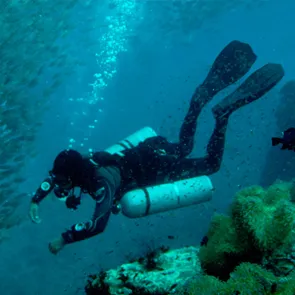
Recreational diving operates within what the industry calls the “no-decompression limit” — a depth and time boundary within which you can ascend directly to the surface at any point during the dive without risking decompression sickness. Your dive computer tracks this in real time. When it says “no deco time: 20 minutes,” you have twenty minutes before the nitrogen dissolved in your tissues exceeds the threshold for safe ascent.
Technical diving operates beyond that limit. Tech divers intentionally exceed the no-decompression boundary, which means they cannot ascend directly. Instead, they must complete mandatory decompression stops — pausing at specific depths for specific durations on the way up, allowing dissolved gas to exit their tissues gradually.
This changes everything. A recreational diver in trouble can go up. A technical diver in trouble must still decompress — which means solving the problem at depth, with the equipment on their back, on the gas they’re carrying. There is no surface. There is only the plan.
This sounds frightening. It is. But it is frightening the way flying a plane or climbing a mountain is frightening — a managed risk that becomes manageable through training, preparation, and the systematic elimination of variables that could go wrong. Technical divers don’t embrace danger. They reduce it to the smallest possible margin through obsessive planning, redundant equipment, and an approach to diving that treats every dive as a procedure to be executed precisely.
The Progression
Nobody walks into a dive centre and signs up for a 60-metre trimix dive. The path from recreational to technical is deliberately graduated, each step building the skills and confidence for the next.
Advanced Nitrox (TDI)
The first step beyond recreational limits. You learn to dive with enriched air mixtures up to 100% oxygen — but this isn’t about extending bottom times. It’s about understanding oxygen: its uses, its dangers, and the limits your body sets on how much you can breathe at depth.
The course focuses on oxygen toxicity and how to manage it, gas planning and the gas laws behind it, and the practical thinking that prepares you for either rebreathers or decompression procedures. There aren’t many new skills to master — this is mostly theory, and it changes how you think about every dive that follows. Gas is no longer just “air.” It’s a tool with properties you manage actively.
Decompression Procedures (TDI)
This is the gateway course. You learn to plan and execute dives that require mandatory decompression stops — down to a maximum of 45 metres. You carry two tanks of back gas, either in a twinset or sidemount configuration, plus a single stage of deco gas — typically 50% nitrox, which is the best choice for this level of diving.
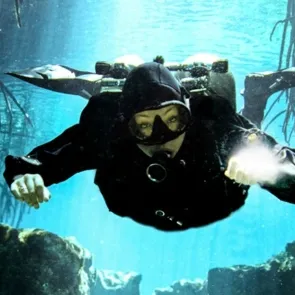
You learn what happens when things go wrong at depth. Lost gas. Free-flowing regulators. A buddy in trouble with thirty minutes of decompression between you and the surface. The training is methodical: identify the problem, evaluate your options, execute the solution, continue the dive. Panic is not one of the options.
Extended Range (TDI)
Deeper still — 55 metres. This is probably the pinnacle course for most technical divers, because helium is expensive and this is where you learn to push air-based diving to its practical limit.
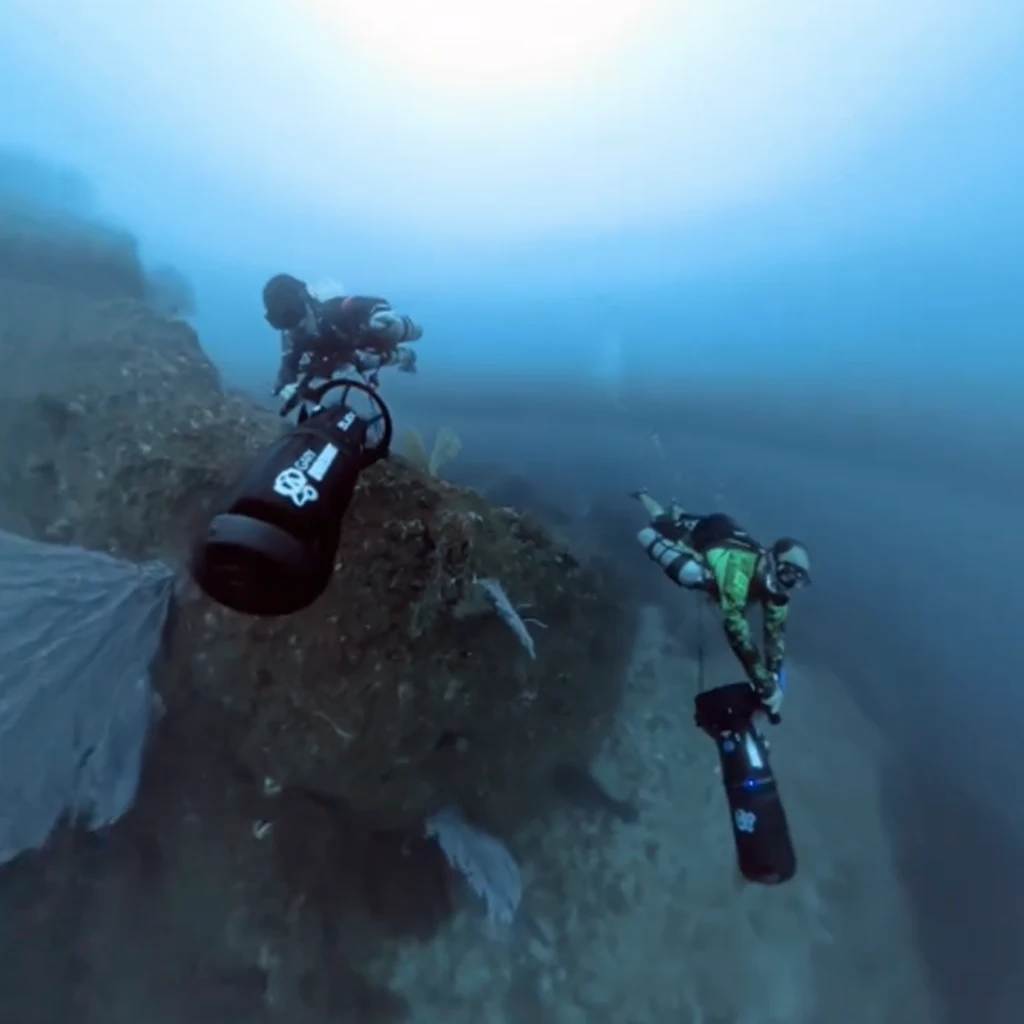
At this depth, two things work against you. Nitrogen narcosis affects your cognitive function — symptoms range from mild euphoria to impaired judgment, and every diver responds differently. Part of the training is learning your own narcosis profile. But the bigger concern many divers underestimate is gas density: at 55 metres, the air you breathe is dense enough that carbon dioxide builds up faster than your body can clear it. That CO2 retention compounds the narcosis, and managing both is the real skill at this level.
This is how Jon and Gary typically dive when exploring Anilao — minimising narcosis and CO2 retention by using DPV scooters to reduce workload and keep breathing rates low.
Why Here
Blue Ribbon Dive Resort is an SDI/TDI 5-Star Dive Centre — one of the few in the Philippines certified to teach the full range of recreational and technical diving courses. Jonathan Venn, who has been diving the Verde Island Passage for sixteen years, holds TDI instructor ratings and has trained technical divers from around the world. Gary Tyson, Jon’s regular dive buddy and fellow instructor, is a TDI Advanced Nitrox and Decompression Procedures instructor — between them, they cover the full technical pathway offered at the resort.

Anilao is a natural training ground for technical diving for several reasons.
Depth is accessible. The reef structure around the Calumpan Peninsula drops steeply — walls that begin at five metres and plummet past sixty. Training dives at 40, 50, and 60 metres don’t require a long boat ride to deep water. They’re a short trip from shore.
The underwater terrain is complex. Volcanic walls with overhangs, swim-throughs, caves, and canyons provide the kind of varied topology that technical training requires. Mapating Rock — its name means “lots of sharks” — has a cave entrance at 45 metres where whitetip reef sharks sleep and hammerheads have been sighted. Kirby’s Rock is a vertical volcanic wall in the middle of the Verde Island Passage with strong currents and dramatic depth profiles.
Conditions are manageable. Visibility in Anilao ranges from good to excellent during the dry season (November through May). Water temperatures hover around 26 to 29 degrees — warm enough for comfort during extended decompression stops. Currents are present but predictable, and local knowledge from years of diving these sites means your instructor knows exactly what the water will do on a given day.
The reward is extraordinary. The deeper walls of the Verde Island Passage host species that recreational divers never see. Deep-sea gorgonians, black coral forests, and pelagic visitors that patrol the drop-offs. The technical diver in Anilao doesn’t just go deeper — they access a part of the most biodiverse marine ecosystem on Earth that is invisible from above.
The Mindset
Technical diving attracts a particular kind of person. Not thrill-seekers — tech diving is too procedural, too methodical, too dependent on planning to satisfy someone looking for adrenaline. The people who pursue it are typically curious, detail-oriented, and comfortable with the idea that managing risk is an ongoing practice, not a box to be ticked.
The transition from recreational to technical diving changes how you think about diving. Air supply, which was once a background number on your computer, becomes the central variable in your dive plan. Buoyancy, which recreational divers learn to manage adequately, must be managed precisely — a technical diver in a decompression stop at six metres must hold that depth within a margin of less than a metre, for as long as the schedule requires. Equipment, which recreational divers strap on and forget, becomes a system you configure, check, and mentally rehearse before every dive.
This sounds like work. It is work. But it’s the kind of work that produces a skill set so refined that every subsequent dive — including recreational dives — becomes better. Technical divers have the best buoyancy, the lowest air consumption, the calmest responses to problems, and the deepest understanding of the physics that govern everything below the surface. The training makes you a better diver at every depth, not just the deep ones.
The First Step
If you’re reading this as a certified recreational diver wondering whether technical diving is for you, the answer is: take the Advanced Nitrox course. It’s the lowest commitment, the smallest step beyond your current training, and the clearest window into what technical diving involves. You’ll learn gas planning, you’ll use enriched air, and you’ll begin to think about diving as something you plan rather than something that happens to you.
If that clicks — if the planning appeals rather than intimidates, if managing variables feels like a puzzle rather than a chore — then the rest of the path will unfold naturally. Decompression procedures. Extended range. Trimix. Cave, if that’s where your curiosity leads.
And all of it can happen here — on the edge of the Verde Island Passage, at depths the recreational world can only imagine, with an instructor who has spent sixteen years learning what this particular reef looks like when you go past the line where the numbers say you should stop.
Blue Ribbon Dive Resort is an SDI/TDI 5-Star Dive Centre in Anilao, Mabini, Batangas. Technical diving courses from Advanced Nitrox through Trimix are available year-round.
