In 1966, someone opened a dive centre in Anilao, Batangas.
Nobody is entirely sure who it was. The date is cited everywhere — on dive travel platforms, tourism boards, resort websites, guide books. “The birthplace of scuba diving in the Philippines.” “The site of the country’s very first dive centre, established in 1966.” But the founder’s name, the centre’s name, and the circumstances of its opening have been quietly lost. The story of Philippine diving begins with an anonymous act.
What we do know is what Anilao was in 1966: a fishing village on the Calumpan Peninsula, two hours south of Manila by rough road, with no tourism infrastructure, no electricity in most barangays, and no particular reason for anyone from the capital to visit. The reef was there, of course — it had been there for millennia — but nobody was looking at it yet. The fishermen of Mabini used dynamite and cyanide because the fish were plentiful and nobody had told them the reef was extraordinary.
Within two decades, that fishing village would become the training ground for thousands of divers from around the world. Within four, a scientific expedition would declare the waters off its shore the most biodiverse marine ecosystem on the planet. The story of how that happened involves a handful of people who saw something in the water that most of the country was ignoring.
The Pioneers
The unnamed 1966 centre was followed quickly by others.
Aqua Tropical Sports Resort opened in 1967 in Barangay Ligaya, making it one of the oldest dive operations in the country. In 1984, it became the first resort in the Philippines affiliated with CMAS — the World Underwater Federation — giving Anilao a direct line to the international diving community at a time when most of the country’s coastline had never seen a regulator.
Aquaventure Reef Club was established in 1971 in Sitio Looc. It would operate for nearly fifty years as what it called, with some justification, “the original dive resort in the Philippines.” In its early decades it was a place frequented by Manila’s wealthy — a private club where the rich and adventurous came to do something that most Filipinos considered, at best, eccentric.
Then came the man who would transform the reef itself.
Doc Tim and the Cathedral
In 1978, Dr. Tim Sevilla — universally known as Doc Tim — founded Dive7000 in Bagalangit, Mabini. The name came from the approximately 7,000 islands of the Philippines. His vision was explicit: the resort would be the hub of diving for the entire country.
Doc Tim was a PADI Course Director who trained thousands of divers over a career spanning decades. But his most remarkable achievement wasn’t in the classroom. It was underwater, on a barren rock formation directly in front of his resort.
The formation was dead rock — no coral, no fish, no colour. Scientists told Sevilla that transplanting live coral onto bare substrate couldn’t be done. He did it anyway. Fragment by fragment, he seeded the rock with living coral. The coral grew. Fish followed. Within years, the barren rock became a thriving reef.
Marine biologist Dr. Doug Fenner of the Australian Institute for Marine Sciences later surveyed the site and documented 67 species of coral on that single formation — out of 411 coral species recorded in the entire Philippines. The Caribbean Sea, by comparison, has roughly 50 species total. A man-made reef in Batangas had more coral diversity than an ocean.
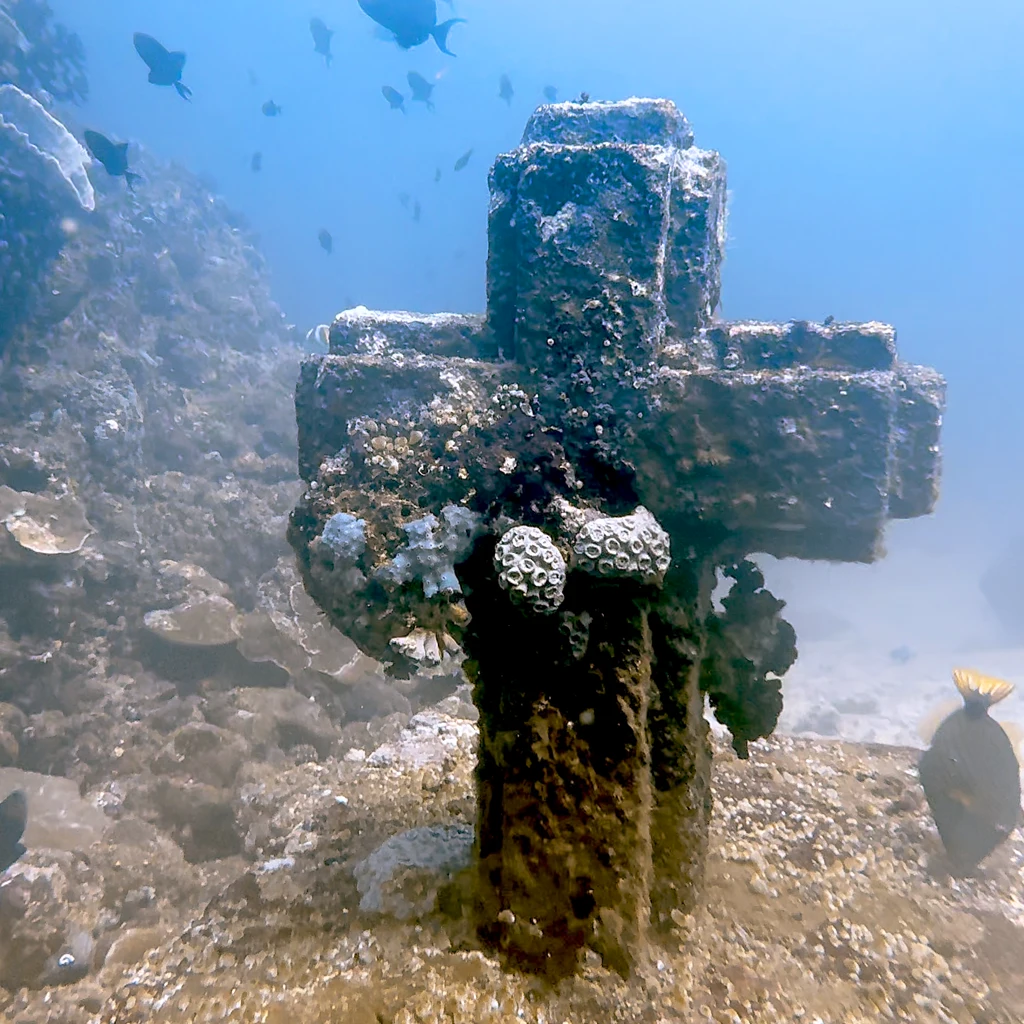
Sevilla and former President Fidel V. Ramos placed a concrete cross between two large boulders at the site. The cross was blessed by Pope John Paul II. Divers began calling the site Cathedral Rock. It is now one of the most famous dive sites in the Philippines, a marine sanctuary within the Mabini Marine Reserve, and a living monument to the fact that reefs can be restored — if someone is stubborn enough to try.
In 2002, Doc Tim became the first Filipino to receive the SSI Platinum Pro Plus Diver Award at the DEMA convention in Las Vegas — international recognition for a life spent proving that a fishing village in Batangas could matter to the world.
Arthur and Lita
Not all of Anilao’s pioneers arrived with grand visions. Some arrived with two rooms and a dream.
In 1984, local divemaster Arturo Abrigonda and his wife Lita opened Arthur’s Place Dive Resort with almost nothing — a couple of rooms, basic equipment, and an intimate knowledge of the reef that no foreigner could match. Arthur knew the dive sites the way a farmer knows his fields: by feel, by season, by the way the current moves on a particular morning.
Arthur died in September 2002. Lita continued. She expanded the resort, trained staff, and built what her husband had started into one of Anilao’s enduring operations. Arthur’s Rock — the dive site named after him — became part of the Mabini Marine Reserve, a permanent fixture of the underwater landscape he helped make famous.
The Conservation Turn
The early decades of Anilao diving were not without contradiction. While a handful of resorts were bringing divers to admire the reef, local fishermen were still destroying it. As late as 1992, visitors reported dynamite fishing within sight of the dive sites — explosions that killed everything within their blast radius, turning living reef to rubble.
The turning point came from an unlikely collaboration. In 1988, the Haribon Foundation — the Philippines’ oldest conservation organisation — began integrated coastal management projects in Mabini, working with marine scientist Dr. Alan White. Their surveys told a grim story: fish abundance was declining, reef health was degrading, and the dynamite was winning.
The response was institutional. In 1991, the Mabini Marine Reserve was established by municipal ordinance — 356 hectares of protected water covering the barangays of Bagalangit and San Teodoro. Three marine sanctuaries were created within it: Cathedral Rock (22.9 hectares), Arthurs Rock (17.9 hectares), and Twin Rocks (15.3 hectares). No-take zones. No fishing. No extraction. The reef, for the first time, had legal protection.
It worked. Not overnight, and not without enforcement battles that continue to this day. But the trajectory changed. The dynamite stopped — mostly. Fish populations recovered — measurably. And the reef, given space, did what reefs do when you leave them alone: it grew.
The Science Catches Up
In 2005, two marine biologists changed Anilao’s story permanently.
Dr. Kent Carpenter of the IUCN and Dr. Victor Springer of the Smithsonian Institution published the results of a comprehensive analysis of marine shorefish distribution. Their conclusion: the Verde Island Passage — the strait between Luzon and Mindoro, the water that Anilao sits directly on — contained the highest concentration of marine shorefish biodiversity ever recorded. 1,736 species in ten square kilometres.
They called it the Center of the Center of Marine Shorefish Biodiversity.
The designation changed everything. Anilao was no longer just “a nice dive spot near Manila.” It was the epicentre of the most biodiverse marine region on the planet — the Coral Triangle’s densest point, measured and published in a peer-reviewed journal. The fishing village that had stumbled into diving in 1966 was sitting on the richest reef system on Earth, and now the world knew it.
In 2006, President Gloria Macapagal-Arroyo issued Executive Order No. 578, identifying the Verde Island Passage Marine Corridor as a critical area for biodiversity conservation. In 2023, Dr. Sylvia Earle’s Mission Blue designated it a Hope Spot. The amateur enterprise of a few resort owners in the 1960s had become an international conservation priority.
The Lens Follows the Reef
Anilao’s transformation from dive destination to underwater photography capital was perhaps inevitable. The biodiversity was there. The macro subjects — nudibranchs, frogfish, cuttlefish, seahorses, octopuses — were extraordinary. And unlike the pelagic destinations that produced dramatic but repetitive wide-angle shots, Anilao offered something different: an infinite gallery of small, strange, impossibly colourful creatures that rewarded patience and sharp eyes over speed and luck.
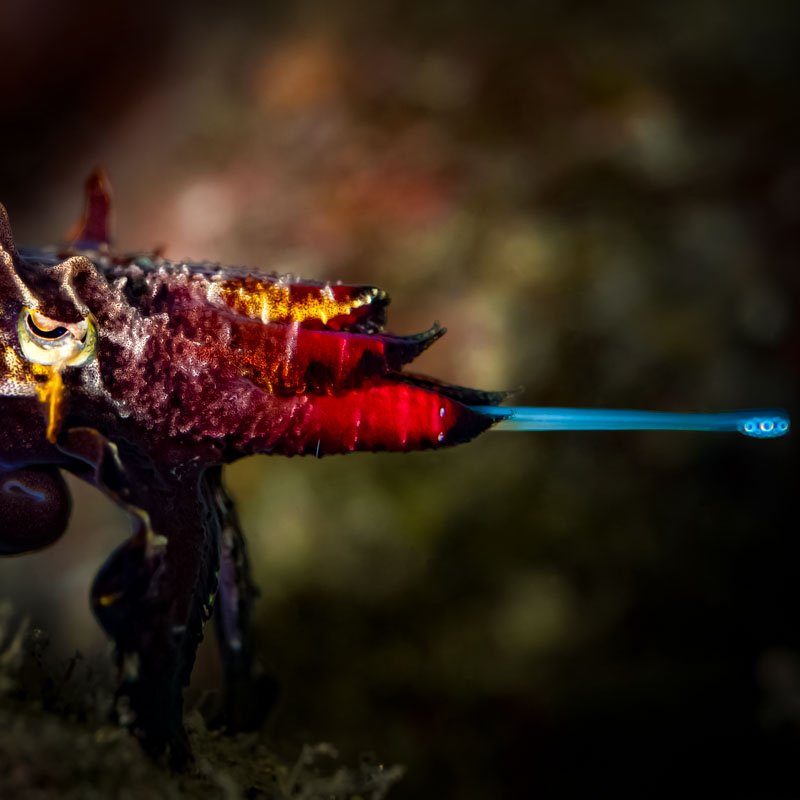
In 2013, the Department of Tourism launched the Anilao Underwater Shootout — quickly dubbed the “World Cup of Underwater Photo Competitions.” It came with a strict no-manipulation policy: no touching marine life, no moving creatures for the shot, no rearranging the reef. Photograph what you find, where you find it, as it is. The competition established Anilao as a destination where the photography ethic was part of the culture, not an afterthought.
Today, Anilao hosts professional underwater photographers from around the world. The macro shooting here — nudibranchs measured in millimetres, frogfish camouflaged against sponges, blue-ringed octopuses glowing on night dives — has produced some of the most celebrated images in underwater photography.
Sixty Years of Water
Anilao in 2026 is not the fishing village of 1966. There are now over fifty dive sites charted along the Calumpan Peninsula. More than 600 species of nudibranch have been documented — earning it the title “Nudibranch Capital of the World.” The marine reserve system that began with three sanctuaries has expanded into a network of 69 no-take zones across the Verde Island Passage. Scientific expeditions continue to discover species here that have never been catalogued anywhere else on Earth.

But some things haven’t changed.
Anilao is still two hours from Manila by car. No flights required. No boats to distant atolls, no liveaboards, no multi-day transits. The richest marine ecosystem ever measured is accessible by road from one of Asia’s largest cities — the same proximity that drew that anonymous founder in 1966.
The divemasters who guide visitors through the reef are still, overwhelmingly, local. They know the sites the way Arthur Abrigonda knew them: by feel, by season, by the way the cuttlefish moves across the sand on a particular afternoon. Many of them grew up in the fishing families that once dynamited the reef they now protect. The transformation is generational, and it is real.
The person who opened that first dive centre in 1966 probably had no idea what was beneath the surface — not in the specific, quantified way that Carpenter and Springer would later describe. They saw clear water, colourful reef, and an opportunity. Everything that followed — the marine reserves, the photography competitions, the Hope Spot designation, the peer-reviewed papers, the 1,736 species count — grew from that simple beginning.
A fishing village. A reef. Someone who looked beneath the surface and decided it mattered.
Sixty years later, the rest of the world is still catching up.
Blue Ribbon Dive Resort is located in Anilao, Mabini, Batangas — at the birthplace of Philippine diving, on the shore of the Verde Island Passage.
Sources
1. ZuBlu — “Anilao: The Philippines’ Most Accessible Dive Destination.” First dive centre, 1966.
2. Aqua Tropical Sports Resort — est. 1967; first CMAS-affiliated resort in the Philippines (1984).
3. Aquaventure Reef Club — est. 1971, Sitio Looc, Mabini.
4. Doc Tim Sevilla — Dive7000 founder (1978); SSI Platinum Pro Plus Award (2002, first Filipino recipient).
5. Fenner, D. — Survey of Cathedral Rock: 67 coral species documented.
6. Haribon Foundation / Dr. Alan White — Mabini ICM projects (1988).
7. Mabini Municipal Ordinance — Marine Reserve established 1991 (356 ha).
8. Carpenter, K.E. & Springer, V.G. (2005). “The center of the center of marine shore fish biodiversity.”
9. Executive Order No. 578 (2006) — Verde Island Passage Marine Corridor.
10. Mission Blue (2023) — Verde Island Passage Hope Spot designation.
11. Department of Tourism — Anilao Underwater Shootout (est. 2013).
12. Arthur’s Place Dive Resort — Arturo Abrigonda, est. 1984.
