You’re going to breathe underwater. You’re going to descend to eighteen metres — the height of a six-storey building, but downward, into the sea. You’re going to learn to control your buoyancy with your lungs, clear your mask while submerged, and manage equipment that looks intimidating until you’ve done it twice and then feels like putting on shoes.
But before any of that happens, you’re probably going to be nervous. That’s normal. Everyone is nervous. The people who say they weren’t are either lying or have forgotten. Here’s what actually happens during a typical SDI Open Water Scuba Diver course, from the first classroom session to the moment you surface from your final dive and realise you’ve become a diver.
Before You Start
Most open water courses involve three components: knowledge development (theory), confined water sessions (pool or shallow, controlled conditions), and open water dives (the real thing — ocean, depth, marine life).
The theory covers the physics of diving — how pressure changes with depth, why you must never hold your breath, how gases behave in your body, what decompression sickness is and how to avoid it. This sounds technical, and it is, but the core concepts are straightforward. If you can understand why your ears pop on a plane, you can understand Boyle’s Law. If you’ve ever fogged up a car windscreen, you understand gas diffusion.
You’ll learn dive planning — how to read a dive table or computer, calculate air consumption, plan maximum depths and bottom times. You’ll learn hand signals, because speech doesn’t work underwater and your hands become your voice. You’ll learn about equipment — what each piece does, how to check it, what to do if something malfunctions.
None of this requires prior experience. You don’t need to be a strong swimmer — comfortable in water is sufficient. You don’t need to be young, athletic, or fearless. The youngest open water divers are ten years old. The oldest are well into their seventies. If you can breathe, you can learn to dive.
Day One: The Pool
The confined water sessions — usually in a pool or sheltered shallow water — are where you learn the physical skills.
The first breath underwater is the strangest. Your brain, which has spent your entire life associating water with not-breathing, takes a moment to accept that air is flowing. The regulator in your mouth delivers air on demand — you breathe in, air comes. You breathe out, bubbles rise. Within a minute or two, the strangeness fades and the breathing becomes natural. It will become so natural, in fact, that by your third or fourth dive you’ll forget you ever found it remarkable.
In the pool, you’ll practice:
- Mask clearing: Water gets in your mask. It happens on every dive, and it’s mildly annoying rather than dangerous. You learn to press the top of the mask to your forehead, look up slightly, and exhale through your nose. The air pushes the water out through the bottom. By the second practice, most students can do it without thinking.
- Regulator recovery: What happens if the regulator falls out of your mouth? You reach back, sweep your arm, and it’s there. You put it back in, blow out to clear the water, and continue breathing. The skill takes about thirty seconds to learn and is almost never needed in real diving — but knowing you can do it removes the fear.
- Buoyancy control: This is the skill that separates divers from people wearing dive equipment. You inflate and deflate your BCD (buoyancy control device) to ascend and descend. But the fine control — hovering motionless at a given depth, rising slowly, descending gently — comes from your breathing. A deep breath makes you rise slightly. An exhale makes you sink. Learning to use your lungs as a buoyancy engine is the single most important skill in diving, and it takes practice. You won’t be perfect in the pool. You won’t be perfect on your first open water dive. But by your fourth, you’ll feel it click.
- Emergency skills: Sharing air with a buddy, controlled emergency ascents, responding to a free-flowing regulator. These are rehearsed methodically so that if they’re ever needed — and for most divers, they never are — the response is automatic.
The pool sessions are repetitive by design. You do each skill until it’s comfortable, then you do it again. The goal isn’t perfection. The goal is confidence — the kind that comes from knowing you’ve practised the thing, in controlled conditions, enough times that it’s no longer a thought but a reflex.
The Open Water Dives
This is where the course comes alive.
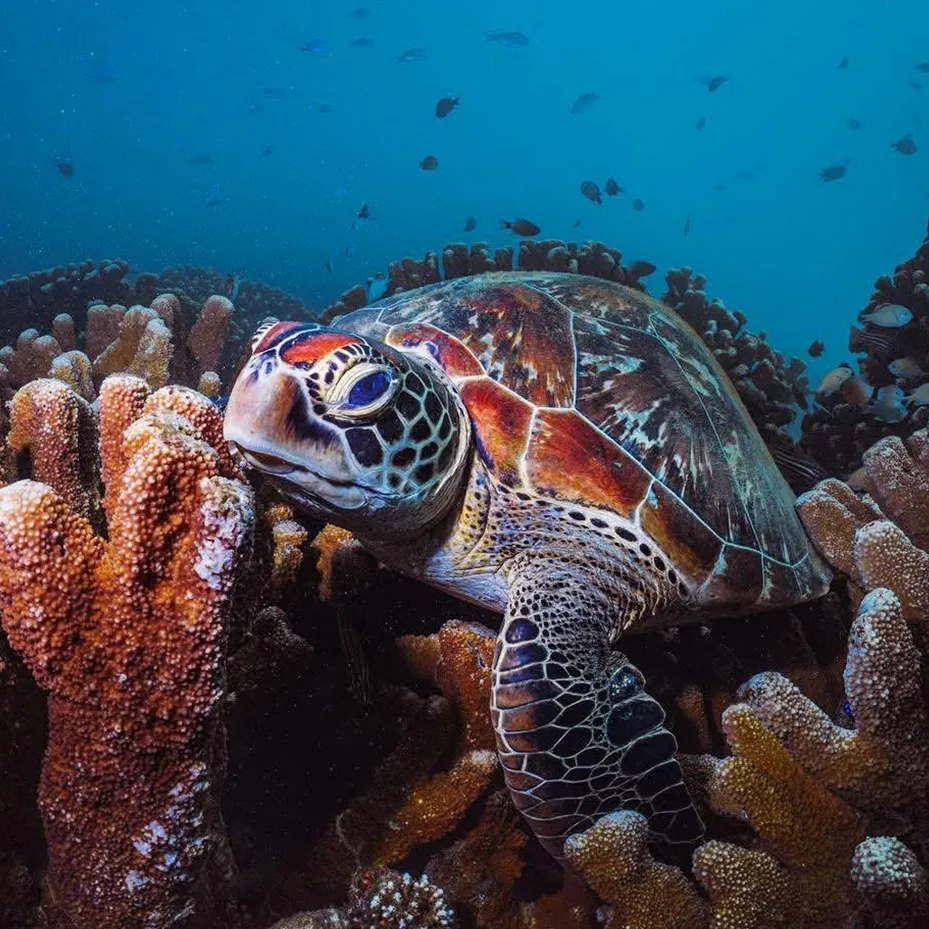
The standard SDI Open Water course includes four open water dives, typically spread over two days. In Anilao, these dives happen on actual reef — not a training lagoon, not a quarry, not a swimming pool with a deeper end. You’re diving in the Verde Island Passage, the most biodiverse marine ecosystem on the planet, from your very first ocean dive.
Dive one is shallow — typically five to eight metres. Your instructor stays close. You descend slowly along a line or slope, equalising your ears every metre or two (pinch your nose, blow gently — the same technique you’d use on a plane). You kneel on the sand. You practise the skills from the pool — mask clearing, regulator recovery — but now there are fish. Actual fish, swimming past your mask while you’re trying to concentrate on the exercise. This is simultaneously distracting and the best possible proof that you’re actually doing it. You’re underwater. In the ocean. Breathing.
Dives two and three take you progressively deeper — twelve metres, then eighteen. The skills become more complex. You practise navigation with a compass. You calculate air consumption. You learn to manage your buoyancy on a real reef, where the terrain changes and the current pushes you sideways and there’s a nudibranch on the wall that your instructor is pointing at with visible enthusiasm.
Dive four is the graduation dive. Eighteen metres — the maximum depth for Open Water certification. By now, the equipment feels familiar. The breathing is automatic. The mask clearing is a minor nuisance, not an event. You’re no longer thinking about diving. You’re diving — looking at the reef, watching the fish, following your buddy, managing your air, and wondering why anyone would choose to stay on the surface when this exists.
The Things No One Tells You
Your air consumption will be terrible at first. New divers breathe fast because they’re excited, nervous, or both. Your first dive might last thirty minutes. Your instructor’s will last sixty on the same tank. This is normal. Air consumption improves with experience — with every dive, you breathe slower, move less, and your body stops interpreting “underwater” as a threat that requires rapid respiration. After twenty dives, you’ll be unrecognisable from your first.
Your ears matter more than you think. Equalisation — clearing the pressure in your ears as you descend — is the skill that causes the most anxiety. If you can equalise on a plane, you can equalise diving. But if you have a cold, congestion, or sinus issues, equalising becomes difficult or impossible, and you should not dive. This is not a recommendation — it’s physics. A blocked Eustachian tube at depth can cause a reverse squeeze that is genuinely painful and potentially harmful. Your instructor will check, and if you can’t equalise, you’ll wait a day. It’s not a failure. It’s your body telling you what it needs.
You will feel cold, even in tropical water. Water conducts heat 25 times faster than air. At 27 degrees, you’ll feel warm for twenty minutes and then cold. Wetsuits help. A 3mm suit is standard in Anilao. If you run cold, ask for a 5mm. Nobody is judging. Being comfortable underwater is more important than looking tough.
Your first dive will be over before you’re ready. This is universally reported. The thirty minutes will feel like five. You’ll surface wanting to go straight back down. This feeling never entirely goes away — which is why divers keep diving for decades.
After Certification
Your Open Water certification has no expiry date. It is recognised worldwide. You can dive to 18 metres at any dive centre on the planet that accepts SDI or its equivalent agencies.
From here, the path branches. Advanced Open Water extends your depth limit to 30 metres and introduces specialities — deep diving, navigation, night diving, peak buoyancy. Rescue Diver teaches you to manage emergencies — your own and others’. Divemaster and beyond are professional certifications for those who want to make diving their career or their life.
Most people don’t take the advanced courses immediately. Most people take their Open Water certification and simply dive — weekend trips, holidays, destination travel. The certification is a licence to explore. Where you go with it is entirely up to you.
Why Here
You can learn to dive in a swimming pool in any city on Earth. You can do your open water dives in a quarry in England or a lake in Southeast Asia or a controlled beach in the Mediterranean.
But you could also do them here — in Anilao, on the Verde Island Passage, on a reef where the fish outnumber the coral and the coral outnumber anything you’ve imagined. Your first ocean dive could be in the most biodiverse marine ecosystem ever measured. Your first mask-clearing exercise could happen while a cuttlefish changes colour three metres away.
The skills are the same wherever you learn them. The physics doesn’t change. The regulator works identically in a quarry and on a reef. But the experience — the thing that makes you want to do it again, and again, and again — starts with what you see when you first open your eyes underwater.
And in Anilao, what you see is everything.
Blue Ribbon Dive Resort is an SDI/TDI 5-Star Dive Centre in Anilao, Mabini, Batangas. Open Water courses run year-round.
